It cold-opens rather disarmingly with a look at a quartet of young men—who bonded in college and who are now making their way deeper into their adult lives, each with major career ambitions—and in this way it reminded me vaguely of the opening of Garth Risk Hallberg’s City on Fire in which we start with a look at what seems at first to be a couple of somewhat derpy dudes on their way to some kind of low-stakes misadventure…before it become a sprawling story with a big ensemble cast and everyone’s world is rocked and I’m in tears.
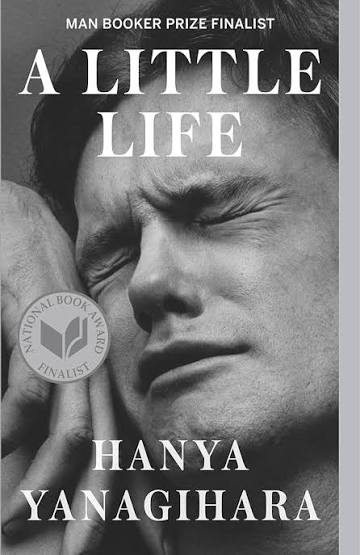
A Little Life works somewhat similarly. The author throws down some key information and flair about each of the central quartet, and I found that I could distinguish them one from the other easily and that I liked all of them. I read this book by way of the audiobook, narrated by Matt Bomer, which I characterized in a comment on Bluesky a few days ago as “31 hours of emotional abuse” over the three days that I took this in. Yeah, the abuse. It would have taken me far longer to have the read the text version because I can’t usually work in that many hours per day of reading a physical book or ebook, but I often can with an audiobook while I’m doing something else very quotidian that occupies no major bandwidth such as some of my admin work in my day-job. But also because I would have had to set it down more often due to not being able to see clearly enough through tears because this fucking book had me weeping continually. The emotional intensity of the story is (I think deliberately) exaggerated, out of proportion in service of showing us a drama of deep friendship and found family.
A note on the narration: Bomer is really good at reading a book. He doesn’t do any obvious exaggerated voices for any characters but he does just enough inflection that it’s easy to believe that I’m hearing dialogue and interiority from a bunch of characters without losing track of who’s who.
I’m gonna put a spoiler warning right here in case the one to three people who might read this post also want to read the book, because in maybe two paragraphs from now I will mention something about the character Jude that I think I was able to glean fairly early in the story but which is not fully revealed until very deep into this 800-page book. Let me also drop a trigger warning for sexual abuse/assault and one for self-harm.
For a little while into A Little Life, it seems like it’s going to be an ensemble story with the action being handed off chapter-by-chapter more or less equally among the quartet of Willem, Malcom, JB and Jude, with these characters periodically intersecting each other’s lives. But eventually—not quite sure when this happens as far as how deep into the book—it becomes a story with a protagonist (Jude) and a deuteragonist (Willem—thank you sweet Willem for a legit excuse to say “deuteragonist” in public), and a supporting cast of Malcom, JB, Andy (a doctor with whom Jude has had a long-running and contentious friendship), Harold (Jude’s law professor who becomes much more than that later in the tale) and Harold’s wife Julia, and a slew of other figures who pop up here and there.
The reader can figure out fairly early on that Jude has no family, and that he probably never had a single friend before he was put with Willem, Malcom and JB in college. There’s also some kind of unspecified thing that’s challenging with his body—he walks with a limp, struggles with stairs, has painful episodes of losing control of his movement. We don’t know why this is for a long time and I’m not revealing that here except to say that I literally gasped with horror at the moment that I understood it. And cried again. So many tears spilled on this goddamned novel. I hope it took the author twenty fucking years to write it.
One thing we learn about Jude fairly early in the book—in a horrifying sequence stretching from him waking up Willem in the night through to a late-night visit to Doctor Andy—is that he’s a cutter. If that’s a no-go for you, don’t read this book. He never stops doing this. It will seem for a while that he’s stopped. But then it happens again. At varying levels of intensity from two little cuts to a bloodbath. I don’t think I’ve ever encountered a depiction of a cutter in fiction or film that feels as real as this. The author either knows a lot about this first-hand or did some very good and empathetic research.
The other thing about Jude—his pre-college life that he keeps to himself so hard that it hurts the hearts of those around him—is that he was rescued by some monks as a newborn baby abandoned in the garbage, and that he’s a victim of sex abuse as a child. I feel like I understood that he’d been abused a lot earlier in the book than when it’s fully revealed through several flashbacks to his childhood and early adolescence. So I don’t know that it’s a big spoiler really to state it here. But…fuck: the sheer volume and duration of abuse that he undergoes as a kid as detailed in the latter half of the story threatens to tip whole thing over into ridiculousness. Like, all of this happened to one kid in this timeframe? Do we really need all of this to understand Jude? It’s almost like if Dennis Cooper were to script a remake of The Perils of Pauline (but it never gets as funny as that would be).
Do I recommend this novel? I don’t know. I’m giving it five stars on my private List of Things with Stars because I think it’s really well-crafted and the character work is absolutely amazing. But I can imagine some readers not getting at all what I’m getting out of it. Oh, one thing about it that I forgot to call attention to earlier to about this novel is that it contains a kind of queer rep quite unlike much of what I’ve seen in “mainstream” and “literary” fiction. In some sectors of genre fiction these things are almost de rigueur but this is a lit/realist book (which adheres to the hallucination that it’s not “genre”). And here there’s a couple modes of queerness and a couple modes of found family, and I love that so much.
And I’m never ever re-reading it.
 Kyler Fey's Page of Things