The other day it occurred to me to listen to some audio of very old science fiction of the type that fascinated me as a child but which I haven’t revisited in very many years. The podcast Lost Sci-Fi has a ton of it. I chose four stories: “The Shambler From the Stars” by Robert Bloch, “The Vibration Wasps” by Frank Belknap Long, “The Red Brain” by Donald Wandrei and “Beyond the Wall of Sleep” by HP Lovecraft.
Let me quickly dispense with three of these with minimal comment. “The Shambler From the Stars” is hyped by the podcast as being among the most important and influential sci-fi stories ever. I think that may somewhat overstate the case. It’s a Lovecraftian Mythos story about a struggling pulp writer (sigh) looking for inspiration in forbidden tomes. The story is notable in the Mythos for introducing De Vermis Mysteriis, a grimoire by the diabolical Ludvig Prinn, joining on a frightful shelf such volumes as The Book of Eibon (added to the Mythos by Clark Ashton Smith) and the infamous Necronomicon by the “mad Arab” Abdul Alhazred, but otherwise it’s a dreadful piece of juvenilia (Bloch was eighteen at the time) by a writer who would get good later and eventually write a lot of good fiction and also work prolifically as a film and TV writer. Frank Belknap Long’s “The Vibration Wasps” has the kind of sci-fi hook that the real heads geek out about–alien bugs that can pass through walls cuz science–but it’s a dull slog, comprised almost entirely of the most turgid info-dumpy dialogue I’ve ever heard in my life. I considered turning it off at about the halfway point, but I persisted to the end. The Lovecraft story, “Beyond the Wall of Sleep,” is a rather minor entry by the architect of cosmic horror, but it was certainly the most laugh-out-loud entertaining of this lot due to the narrator’s sustained emphasis on how lowly, decadent, dissipated, stupid, illiterate, and ugly the subject of the tale is.
The one stand-out among this sad collection that I imposed upon myself is the Wandrei story. Wandrei was an early Lovecraft acolyte, corresponding while still a teenager with HPL, and even hitchhiking from Minnesota to Rhode Island to meet his mentor. Wandrei wrote “The Red Brain” at age sixteen and showed it to Lovecraft, who evidently endorsed it for publication in Weird Tales. According to the lore, Wandrei would a couple years later demand that Weird Tales editor Farnsworth Wright publish “The Call of Cthulhu,” after initially rejecting it, or else Lovecraft would take his stories elsewhere. If true, this threat from a relative youngster worked and the rest is history. Wandrei would later team up with August Derleth to found Arkham House, the publisher that reprinted Lovecraft’s fiction in book form and, in doing so, preserved what may have been a forgotten body of work.
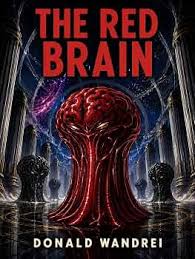
“The Red Brain” is not, in the quality of its prose or in its narrative, exactly something that would be considered “good” by the standards of present-day fiction editors but it expresses a very high concept and rather eerie premise: all the stars of the visible universe, as seen from a planet in orbit of the giant star Antares, are winking out, consumed by a mysterious cosmic dust. This is presented in a way that suggests a timescale of millions of years, like Olaf Stapledon’s First and Last Men. The Antareans have evolved over the course of the ages into beings that are just big brains. As an OG Star Trek boy, I picture the pulsing brains-in-bubbles titular characters of “The Gamesters of Triskelion.” Everything that the brain people have tried to stop the advance of the Cosmic Dust (evidently including the genocide of the Betelgeuse system) over millions of years has failed, and the end for them is very near. All that remains for them is to prepare for their inevitable extinction and be brave about it. But one of their number, a being called the Red Brain, calls together a conference of brains for the first time in twelve thousand years to present a solution, alas, to the Cosmic Dust situation. SPOILER ALERT FOR A CENTURY-OLD PULP SCI-FI SHORT STORY THAT NONE OF YOU WILL EVER READ….
The convocation of the big brains happens but it all goes to shit quickly because…the Red Brain is mad! And everyone dies by evanescing into a gruesome liquid.
Why do I like this? I think it has much to do with it being the creation of an imaginative teenager. When I was sixteen, I was very occupied with the idea of writing short sci-fi or fantasy or horror of the kind that I read in magazines like Asimov’s and Analog and F&SF and (the too-short-lived) Twilight Zone. It was a very important goal at the time to write things that would be published in magazines like those. I never got anywhere close to doing that, and now I don’t really care. Publishing short stories is of zero interest to adult-me. But back then, I think a lot of my failure to create decent stories had to do with taking too seriously stuff like “The Red Brain” and the like from that era that was already so outdated when I was reading that stuff in old anthologies that I’d grab from remainder tables at Waldenbooks. Toward the end of high school, I somehow caught up with the New Wave (which was also already pretty old) and cyberpunk and eventually the mind-blowing horror of the Dell Abyss books and zines like Grue. And I was like “Why the fuck were you reading 1930s sci-fi and thinking that had any future?” I made it to college and read high modernists and Victorian pulps and eventually William Burroughs and Harlan Ellison and Samuel Delany and Ursula Le Guin and Joanna Russ and Stephen Fucking King (did you know that Cujo’s a fucking arthouse novel?).
Anyway, I grew up to some extent through all of these reading and attempted writing experiences. I’m not that aggrieved now about my writing situation not having turned out like teenage-me had expected, but when I read “The Red Brain” written by a kid with relatable ambitions so many years ago it kind of makes me feel a little bit of that sense of wonder and creative power that I felt when I was at that age.

